Maharashtra Government Sends 52 Progressive Farmers on Europe Study Tour; Subsidy Doubled to ₹2 Lakh
Maharashtra
Maharashtra sends 52 farmers to Europe on a government-backed agricultural study tour with subsidy doubled to ₹2 lakh to boost farm innovation and global best practices.
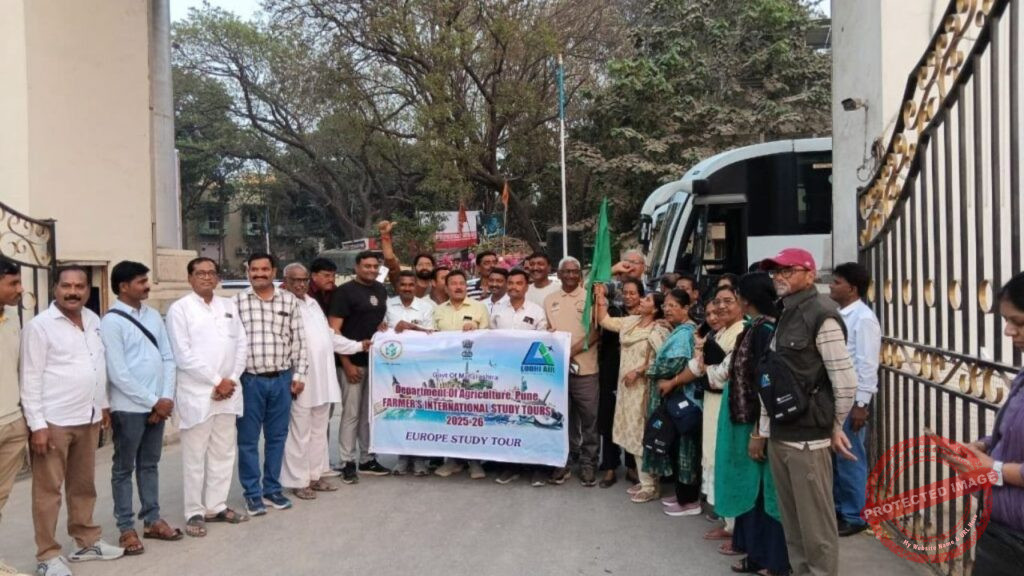
Pune | 16 February, 2026- In a major push toward modernising agriculture and empowering grassroots farming communities, the Maharashtra government has flagged off 52 progressive farmers on a Europe study tour for the 2025–26 agricultural year. The initiative aims to expose farmers to advanced global farming technologies, sustainable cultivation practices, and cooperative agricultural models that can be adapted to local conditions across the state. The delegation departed from Pune amid strong emphasis on knowledge exchange and innovation-led growth in the agriculture sector.
The study tour will cover leading agricultural nations including France, Switzerland, Netherlands, and Germany. During their visit, farmers will gain firsthand exposure to mechanised dairy units, precision farming technologies, organic agriculture systems, greenhouse management, advanced irrigation practices, and large-scale cooperative farming models. The programme has been designed to provide practical learning rather than just observational visits, ensuring that participants return with actionable insights.
One of the key highlights of this year’s initiative is the doubling of financial assistance provided to each participating farmer—from ₹1 lakh to ₹2 lakh. The enhanced subsidy aims to offset rising travel expenses and foreign exchange costs, ensuring that financial constraints do not prevent deserving farmers from participating. Agriculture Minister Dattatray Bharane interacted with the farmers prior to departure and encouraged them to closely study innovative practices and share their learning with local farmer groups upon return.
The Maharashtra government views the tour as part of a broader strategy to strengthen Farmer Producer Organisations (FPOs), promote climate-resilient agriculture, and increase farm productivity. Officials believe that exposure to European agricultural models—known for efficiency, sustainability, and high value addition—can help Maharashtra farmers transition toward more profitable and technology-driven farming systems.
Agricultural experts point out that European nations have made significant advancements in precision agriculture, automation, and resource-efficient cultivation. The Netherlands, for example, is globally recognised for high-yield greenhouse farming and water management efficiency, despite limited land availability. Similarly, Germany’s cooperative structures and France’s mechanised grain and dairy farming systems offer valuable lessons in scaling up productivity while maintaining sustainability standards.
For Maharashtra, where farmers frequently face challenges such as erratic rainfall, fluctuating market prices, and rising input costs, global exposure can play a transformative role. Experts argue that international study tours allow farmers to rethink traditional practices, diversify crops, adopt advanced irrigation systems, and explore agro-processing and export opportunities.
Upon their return, the 52 farmers are expected to conduct district-level knowledge-sharing sessions and workshops. These sessions will aim to disseminate insights into modern techniques such as precision seeding, soil health monitoring, organic certification standards, cooperative marketing strategies, and advanced dairy management. The state government hopes that these participants will serve as “knowledge ambassadors,” multiplying the impact of the tour across farming communities.
The initiative also reflects Maharashtra’s increasing focus on sustainable and climate-smart agriculture. With climate change intensifying weather unpredictability, learning from countries that have successfully integrated technology and sustainability into mainstream farming could provide practical solutions for local challenges.
Policy analysts believe that such international exposure programmes may also open doors for future collaborations between Indian and European agri-tech institutions, potentially facilitating technology transfers, joint research, and export-oriented growth.
Follow us On Our Social media Handles :
Instagram
Youtube
Facebook
Twitter
Also Read- Pune