Brazilian woman in Rahul Gandhi’s voter-fraud claim breaks silence on viral photo
Rahul Gandhi
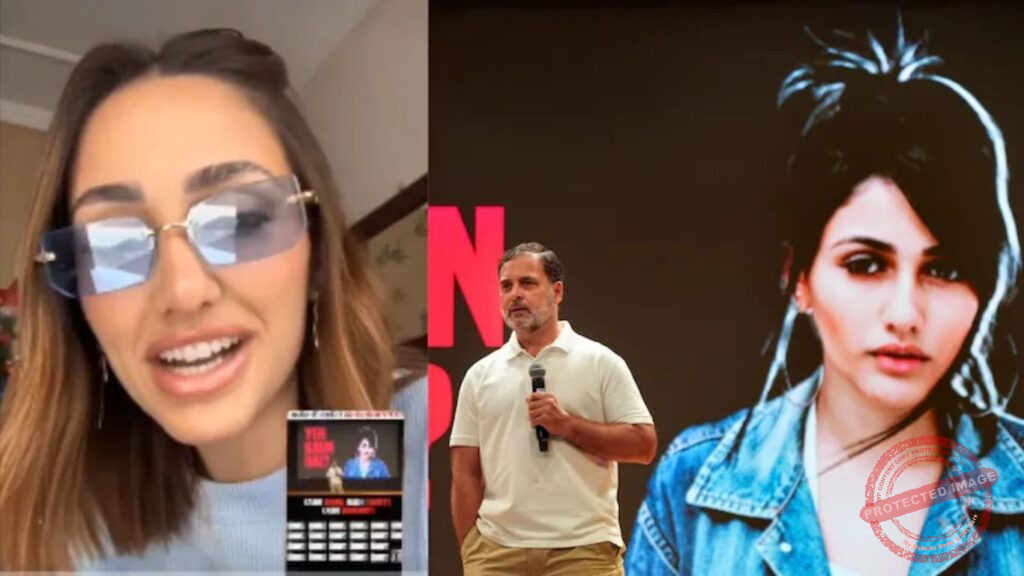
Brazilian woman Larissa Nery responds after her old photo appeared in Rahul Gandhi’s allegations of voter fraud in Haryana. She says the image was misused and has nothing to do with Indian elections.
NEW DELHI, 06 November 2025 – A Brazilian woman named Larissa Nery has unexpectedly found herself pulled into a major political flashpoint in India after Congress leader Rahul Gandhi used her picture during allegations of large-scale voter fraud in the 2024 Haryana Assembly election. Gandhi had claimed that a single woman’s photograph appeared more than twenty times in the voter list under different names and was used to cast multiple votes across polling booths. The image attached to that allegation turned out to be a photograph of Larissa, who says she had no idea her picture was being circulated in India until social-media users began tagging her.
Larissa posted a video reacting to the controversy. Speaking in a mix of disbelief and frustration, she said the photo being used is nearly a decade old and was uploaded to a free stock-image platform years ago. She explained that she is not a model by profession, despite being repeatedly referred to that way online, and that she took the picture as a favour to a friend when she was around eighteen or twenty. She added that she has no connection to India’s elections, has never been to India and had no knowledge of how her image ended up in political material. Her reaction suggested both confusion and concern over how casually her identity was inserted into a heated public debate in another country.
Rahul Gandhi’s claim had triggered intense discussion, with several opposition leaders amplifying the example to question the credibility of the voter list and the broader electoral process. Gandhi argued that repeated entries of the same image pointed to systematic manipulation and that such cases damaged trust in democratic procedures. The issue quickly turned into a political flashpoint, with his supporters viewing it as evidence of structural failure while his critics accused him of sensationalism.
As the story spread, Larissa’s face circulated widely across Indian media platforms, often framed as proof of duplicate voting. Once Larissa responded, the conversation took a new turn. Her statement raised questions about how the photograph entered the voter-ID system in the first place and whether it was used intentionally, accidentally, or through a data-entry error. The Election Commission has maintained that objections were not raised by polling agents at the time of voting and that Gandhi’s claims are being analysed. Political opponents of the Congress leadership have criticised the presentation of the example, saying that the absence of verified documentation should have been clarified upfront.
For Larissa, the situation is surreal. She stressed in her message that she likes India and Indian people, but was baffled by how her face was linked to a claim of election tampering. She urged people not to misuse her identity and asked them to understand that she has no involvement and no control over how her old picture travelled online. Her remarks also highlight a broader issue in the digital age: once an image enters an open-source or stock-photo environment, it can be downloaded and repurposed endlessly, often without the subject’s knowledge.
The episode has sparked debate on digital safety, voter-roll management and political communication. It shows how an ordinary personal photograph from another continent can suddenly become central to a high-stakes argument in a different country altogether. As the controversy continues, Larissa’s unexpected role has become an example of how global the consequences of online image circulation can be, especially when political narratives and viral content intersect.
Follow us On Our Social media Handles :
Instagram
Youtube
Facebook
Twitter
Also Read- Pune