Owaisi Questions Fairness After Ayodhya Verdict, Refers to Court Incident

Owaisi Questions Fairness After Ayodhya Verdict, Refers to Court Incident
AIMIM leader Asaduddin Owaisi asked why no one from his community ever hurled a shoe at a judge, referencing a recent courtroom incident in his remarks after the Ayodhya verdict.
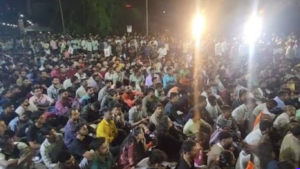
Hyderabad November 24, 2025 – During a public address, Asaduddin Owaisi, leader of the All India Majlis-e-Ittehadul Muslimeen, raised questions about perceived bias in the judicial process in India. He referred to the 2019 Ayodhya verdict, saying that while the ruling did not favour his community, there was a lack of visible outrage when someone attempted to throw a shoe at a judge of the Supreme Court of India. “The judgment was not in our favour, but did a Muslim ever go and throw a shoe at a judge?” he asked. His comments came during a gathering where he also addressed issues of minority treatment and national belonging.
Owaisi pointed to an incident in which a lawyer inside the Supreme Court’s courtroom attempted to throw a shoe at Chief Justice B. R. Gavai. The attempt occurred after remarks by the judge were interpreted as mocking an aspect of faith. Owaisi noted that the accused was not charged and questioned whether the outcome would have been the same if the person had been from a different community. He argued this indicated differential treatment and raised concerns about whether all citizens are treated equally under the law.
In his remarks, Owaisi also addressed the broader sentiments of his community. He said that despite the judgment not going their way, members of his community have remained loyal to the country and will continue to do so. He added that the nation cannot progress if a large group of its citizens is treated with mistrust or hatred. Owaisi appealed to the government and society at large to reflect on whether communities are being asked to prove their loyalty or treated as second-class citizens.
Observers note that Owaisi’s statements may be part of a larger strategy of civic engagement ahead of upcoming elections. His comments reflect long-standing concerns among some citizens about equal application of justice and institutional bias. Legal analysts say while freedom of speech allows political leaders to raise such questions, attributing motive or bias to law-enforcement and court systems requires careful evidence. The courtroom shoe-throwing incident already raised questions about courtroom security and how quickly discipline was applied; Owaisi’s remarks layer on the issue of community-based differential response.
Political commentators say the remarks are likely to resonate among voters who feel under-represented or unfairly treated. However, critics argue that political leaders must ensure their statements do not widen social fault-lines or imply collective guilt or victimhood based solely on identity. The timing of these remarks—relating back to the Ayodhya ruling, which remains sensitive—may spark renewed debate on communal harmony, judicial independence and political accountability.
For now, Owaisi’s talk stands as a call to reflection: about how courts, police, and the public respond to incidents depending on the individuals involved, and how citizens view justice in everyday life. Whether it shifts policy or public discourse remains to be seen, but the impact on dialogue around identity, justice and democracy will likely continue.